
- Corporate governance structure
- Overview of meeting bodies and committees
- History of governance
- Appointment process of directors and Audit & Supervisory Board members
- Matters deliberated by the Board of Directors
- Evaluation of the effectiveness of the Board of Directors
- Skills matrix
- Ensuring of the expertise, independence, and diversity of the Board of Directors
- Remuneration for officers
- Activities of the Nomination Committee and the Remuneration Committee
- Cross-shareholdings
- Succession planning
To remain the firm trust and confidence of society, Rengo’s goal is timely and accurate information disclosure combined with sound and highly transparent management, with a mission to solve socially relevant issues through packaging. In keeping with our fundamental philosophy, which states that "The truth is in the workplace," we are enhancing corporate governance by strengthening the current system of directors and Audit & Supervisory Board members while delegating authority and accelerating decision-making.
Corporate governance structure
As a company with an Audit & Supervisory Board, Rengo is making efforts to enhance its management transparency and strengthen its supervision of management. Our Audit & Supervisory Board, internal audit organization, and other related bodies collaborate to secure audit schedules and structures, ensuring appropriate auditing by the external Accounting Auditor. Audit & Supervisory Board members monitor the directors’ performance of duties and the operations, as well as the business and financial conditions of Rengo and its subsidiaries.
In addition to the Board of Directors Meetings, as a general rule, Senior Executives Meetings, Internal Officers Meetings (attended by full-time officers), Department Liaison Meetings, and other meetings are held at least once per month to make decisions promptly and share important information, thereby performing duties in an efficient manner.
Corporate Governance Structure
| Organizational form | Company with an Audit & Supervisory Board | ||
|---|---|---|---|
| Number of directors | 10 | ||
| Number of outside directors | 4 | ||
| Number of independent outside directors | 4 | ||
| Number of Audit & Supervisory Board members | 5 | ||
| Number of outside Audit & Supervisory Board members | 3 | ||
| Number of independent outside auditors | 3 | ||
| Term of office of directors | 1 | ||
Corporate governance structure (as of June 26, 2026)
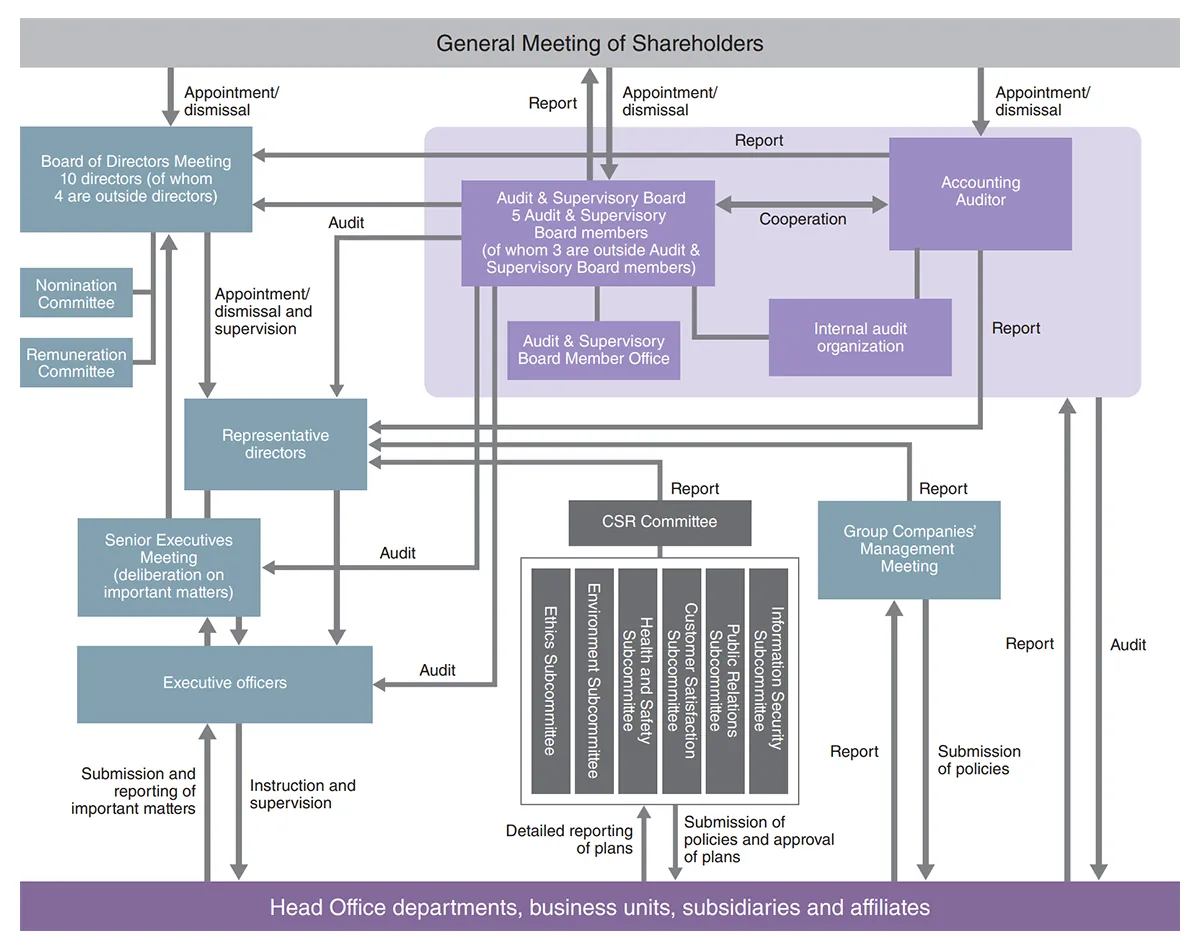
Overview of meeting bodies and committees
| Board of Directors Meeting | To achieve sustainable growth and improve medium- to long-term corporate value, the Board of Directors strives to ensure the effectiveness of its business execution and supervisory functions from an objective standpoint, taking into account the fiduciary duties and accountability to shareholders and attaching importance to the roles of independent outside directors. |
|---|---|
| Senior Executives Meeting | Senior Executives Meetings are attended by the chairman & CEO, the president & COO, the executive vice presidents, and senior managing executive officers and managing executive officers who have been appointed as members of the meeting. In principle, meetings are held at least once a month to discuss and resolve matters to be submitted to the Board of Directors Meetings, important matters concerning the performance of duties, and important matters to be approved, among other matters. |
| Nomination Committee | The Nomination Committee meets regularly and deliberates on matters such as the appointment and dismissal of directors, in response to consultation by the Board of Directors. The committee consists of six members: four outside directors, the chairman & CEO, and the president & COO. An outside director chairs the committee. |
| Remuneration Committee | The Remuneration Committee meets regularly and deliberates on matters such as remuneration for directors and other officers, in response to consultation by the Board of Directors. The committee consists of six members: four outside directors, the chairman & CEO, and the president & COO. An outside director chairs the committee. |
| Group Companies’ Management Meeting | Group Companies’ Management Meetings are held regularly, attended by Rengo’s officers, including the chairman & CEO and the president & COO, and representatives from Rengo Group companies. The meeting thus ensures that important managerial matters and risk management measures are shared across the Group. |
History of governance
- Introduction of an executive officer system
Rengo introduced an executive officer system in April 2007 to strengthen the decision-making, supervisory, and business execution functions of the management.
- Reduction in the number of directors
At the Ordinary General Meeting of Shareholders held in June 2007, the Articles of Incorporation were amended to reduce the maximum number of directors from 24 to 18. The number of directors appointed at that meeting was reduced to 15. The total number of directors as of the conclusion of the Ordinary General Meeting of Shareholders held in June 2026 is 10.
- Appointment of outside directors
Rengo has conventionally appointed outside directors and has taken the following actions in response to the establishment of the Corporate Governance Code:
- Appointed two independent outside directors at the Ordinary General Meeting of Shareholders held in June 2017
- Appointed three independent outside directors at the Ordinary General Meeting of Shareholders held in June 2020
- Appointed four independent outside directors at the Ordinary General Meeting of Shareholders held in June 2021*
- (Note)A total of 10 directors were appointed at the meeting mentioned in 3 above. Outside directors have come to account for one-third or more of the Board of Directors, and the Board’s diversity increased with the appointment of one female outside director.
- Evaluation and disclosure of the effectiveness of the Board of Directors
Rengo conducted a questionnaire-style evaluation of effectiveness and disclosed an overview of the evaluation in a report relating to corporate governance filed on June 30, 2017. The evaluation has been carried out every year since then.
- Abolition of takeover defense measures
Due to the expiration of the effective period, takeover defense measures were abolished at the conclusion of the Ordinary General Meeting of Shareholders held in June 2019.
- Adoption of independent consultation committees
Effective December 17, 2019, Rengo established a Nomination Committee and a Remuneration Committee as voluntary consultation bodies for the Board of Directors. The committees deliberate on matters consulted by the Board.
- (Note)The committees are chaired by an outside director.
- Disclosure of skills matrix
Rengo started to disclose the skills matrix of director candidates in the notice of the Ordinary General Meeting of Shareholders held in June 2022.
Appointment process of directors and Audit & Supervisory Board members
In nominating candidates for directors and Audit & Supervisory Board members, Rengo nominates persons who have a wealth of experience, high levels of insight, and expertise conducive to effective corporate governance, sustainable growth, and medium- to long-term corporate value improvement. The Nomination Committee, a consultation body for the Board of Directors, deliberates on the nomination before the Board thoroughly deliberates on the matter and nominates the candidates. Candidates for Audit & Supervisory Board members are nominated with the consent of the Audit & Supervisory Board.
Matters deliberated by the Board of Directors
Rengo’s Board of Directors holds not only regular meetings but extraordinary meetings as necessary. The Board makes decisions on matters stipulated by laws and regulations and important managerial matters, as well as constantly supervises the status of business execution.
In FY3/2026, nine regular Board of Directors Meetings were held, where the Board deliberated on 47 items to be resolved or approved and 43 items reported.
At the Board of Directors Meetings, outside directors and outside Audit & Supervisory Board members have made suggestions to further enhance the Board functions. Steady efforts are underway to enhance these functions.
Evaluation of the effectiveness of the Board of Directors
Regarding the effectiveness of the Board of Directors, Rengo works to enhance the functions of the Board by conducting an annual questionnaire survey (self-evaluation) of directors and Audit & Supervisory Board members, including outside officers, followed by the report and discussion about the results of its analysis at a Board of Directors Meeting.
Based on the results of the FY3/2026 questionnaire survey, it was confirmed that the overall effectiveness of the Board is being maintained.
Directors and Audit & Supervisory Board members have provided constructive input and suggestions regarding improvements to the composition, roles, and operation of the Board, and have shared issues facing the Board.
Discussions and efforts are underway to put these input and suggestions into practice.
We will continue to work to enhance the functions of the Board by regularly analyzing and evaluating its effectiveness.
Skills matrix
The skills matrix below outlines Rengo’s expectations by field for directors based on their knowledge, experience, and abilities.
| Name | Position in the company | Outside | Corporate management | Sales & marketing | Finance & accounting | Governance | Sustainability | Global | Nomination Committee | Remuneration Committee |
|---|---|---|---|---|---|---|---|---|---|---|
| Kiyoshi Otsubo | Representative Director, Chairman & CEO | ● | ● | ● | ○ | ○ | ||||
| Yosuke Kawamoto | Representative Director, President & COO | ● | ● | ● | ○ | ○ | ||||
| Hiromi Sambe | Member of the Board, Executive Vice President | ● | ● | |||||||
| Ichiro Hasegawa | Member of the Board, Executive Vice President | ● | ● | |||||||
| Hirofumi Hori | Member of the Board, Executive Vice President | ● | ● | |||||||
| Sadatoshi Inoue | Member of the Board, Executive Vice President | ● | ● | |||||||
| Yoshio Sato | Director | ○ | ● | ● | ○ | ○ | ||||
| Masayuki Oku | Director | ○ | ● | ● | ○ (Chair) |
○ (Chair) |
||||
| Kaoru Tamaoka | Director | ○ | ● | ● | ○ | ○ | ||||
| Koichi Sumida | Director | ○ | ● | ● | ○ | ○ |
- (Note)Regarding the knowledge, experience, and abilities expected of each director, we have noted up to three fields of expertise for the chairman & CEO and the president & COO, and up to two for other positions within the company.
The above matrix does not represent all the knowledge, experience, and abilities of each director.
Ensuring of the expertise, independence, and diversity of the Board of Directors
As of June 26, 2026, the Company forms its Board of Directors with 10 members. In nominating directors, we comprehensively evaluate candidates’ experience, knowledge, and expertise and make holistic decisions. To ensure the effectiveness of supervision and practical discussions among the directors, we nominate directors with an eye toward the overall balance and diversity of the Board of Directors.
Furthermore, we have appointed four independent outside directors, thus allowing for opinions stated from an independent stance during discussions at the Board of Directors Meetings. In addition to meeting the criteria for outside directors in accordance with the Companies Act and satisfying the qualifications for independent directors/auditors with no potential conflicts of interest with ordinary shareholders stipulated by the Tokyo Stock Exchange, candidates who can contribute to sustainable growth and increasing corporate value over the medium- to long-term are selected as outside directors.
One of our 10 directors is a female outside director. With this appointment, outside directors now account for one-third or more of the Board of Directors and the diversity of its membership has also been ensured.
Three outside Audit & Supervisory Board members have been appointed, and they fulfill their roles and duties independently, making full use of their high level of specialist knowledge and broad experience, as well as offering an appropriate level of input at the Board of Directors Meetings.
Remuneration for officers
Rengo has adopted a remuneration system for officers that is linked to medium- to long-term performance in order to provide healthy incentives for achieving sustainable growth. We also provide stock compensation, appropriately set the ratio of cash to stock compensation, and have a shareholders’ association of officers to manage the company with a focus on increasing corporate value.
The amount of remuneration for directors is determined within the scope of the total amount of remuneration (including the amount of remuneration based on the stock remuneration plan) approved by the General Meeting of Shareholders. In determining the remuneration level, consideration is given to social trends in director remuneration, our business performance, balance with employee salaries, and other matters that should be taken into account. Directors’ remuneration consists of basic remuneration, performance-based remuneration (bonuses), and non-monetary remuneration (stock compensation). To ensure independence and other points of view, remuneration for outside directors consists solely of basic remuneration.
Basic remuneration is paid monthly as fixed monetary remuneration. The amount is determined in accordance with the rank of executive officers as which the recipients serve concurrently.
Performance-based remuneration is paid in the form of monetary bonuses. The amount is determined in accordance with the rank of executive officers as which the recipients serve concurrently, with consideration given to business performance for the fiscal year (mainly operating income and ordinary income) and with other factors. Performance-based remuneration, if paid, is distributed at a specific time after the fiscal year ends.
Stock compensation in the form of Board benefit trust constitutes non-monetary remuneration. The number of shares granted is equivalent to the number of points given in accordance with the rank of executive officers as which the recipients serve concurrently, and is set within the scope of the upper limit of cash contributed by the company and the maximum number of points given to eligible directors, which have been approved by the General Meeting of Shareholders. Shares are granted to eligible directors at a certain timing after their retirement (after their retirement as executive officers if they continue to serve as executive officers).
The details of remuneration for individual directors are determined by resolution of the Board of Directors, after deliberation by the Remuneration Committee, a consultation body for the Board.
The amount of remuneration for Audit & Supervisory Board Members is determined through consultation among the Audit & Supervisory Board Members within the scope of the total amount of remuneration approved by the General Meeting of Shareholders.
| Disclosure of remuneration | Total amount* |
|---|---|
| Policy on determining remuneration amounts and calculation methods | Established |
*Information is disclosed separately for directors with a total remuneration amount of 100 million yen or more.
Activities of the Nomination Committee and the Remuneration Committee
Rengo has established a Nomination Committee and a Remuneration Committee as voluntary consultation bodies for the Board of Directors. Each of these committees consists of three or more directors appointed through the Board’s resolution, a majority of whom are outside directors, and the position of chair in each committee is held by an outside director.
To strengthen the independence, objectivity, and accountability of the Board functions with appropriate engagement of and advice from outside directors, the Nomination Committee and the Remuneration Committee meet regularly and deliberate on matters such as the appointment and dismissal of directors and other officers and remuneration of them respectively, in response to consultation by the Board.
Cross-shareholdings
To build and strengthen stable, long-term relationships with business partners, Rengo may acquire and hold their shares if doing so is considered conducive to the company’s sustainable growth and medium- to long-term corporate value improvement. For all strategic shareholdings, we verify the medium- to long-term economic rationality and the holding effects from the perspective of maintaining and strengthening comprehensive relationships with business partners, and report the results to the Board of Directors. We also disclose the holding status and verified holding purposes in our securities report. We consider reducing cross-shareholdings that have lost significance, after evaluating whether the risks and benefits justify the cost of shareholder’s equity.
Succession planning
Rengo proactively engages in succession planning for the CEO and other officers by appointing and nominating senior executives and directors at the Board of Directors Meetings. We provide appropriate supervision so that sufficient time and resources are invested systematically in the development of successor candidates.