
The Rengo Group uses wood raw materials (wood chips, pulp, and wood fuel) to produce pulp, paper, paperboard, and cellulose-related products.
Our Procurement Policy for Wood Raw Materials states that, when procuring the raw materials for these products, we must not only consider the global environment and biodiversity, but we must also procure the raw materials from suppliers that do not use illegally logged wood to ensure the effective use of sustainable wood resources.
Procurement Policy for Wood Raw Materials
The Rengo Group procures raw materials derived from wood produced from sustainably managed forests to protect the global environment and biodiversity and combat deforestation.
This procurement policy applies to wood chips, pulp, and wood fuel procured by Rengo Co., Ltd. and its Group companies.
Procurement Policy
- We will procure wood raw materials that have been produced in properly managed forests that comply with local laws and regulations.
- We will prioritize the procurement of reused and unused materials such as waste timber, thinned wood, and low-quality timber to ensure effective use of resources. Also, in order to make sustainable use of forest resources while recycling them, we will give priority to procurement of raw materials derived from timber plantations.
- We will not procure raw materials sourced from illegal logging, wood from conservation-worthy forests, and wood obtained in circumstances that have infringed human rights or traditional rights.
- We will procure from suppliers that comply with laws, regulations and social norms, which show due consideration for human rights, the environment, and society.
- We will prioritize procurement of wood raw materials that have received third-party forest certification. In particular, we will only procure pulp that has received third-party forest certification.
- We will strive to ensure traceability and confirm the legality of wood used for raw materials.
Initiatives Against Illegal Logging
- We will keep the relevant documents for a minimum of five years and make them available at the request of auditors or other such persons.
- We will undertake an annual audit by the Japan Paper Association’s Monitoring Service against Illegal Logging.
- We will regularly provide summaries of the Rengo Group’s initiatives against illegal logging on our website and other media.
Established October 2007
Revised April 2017
Revised April 2018
Revised October 2023
Illegal logging countermeasures
Roughly 90% of the wood pulp Rengo uses is procured domestically, while roughly 10% is imported. All of the wood pulp we procure has received forest management certification from third-party certification bodies.
As part of our illegal logging countermeasures, in order to confirm that raw materials are procured in accordance with our procurement policy, we undertake annual audits by the Japan Paper Association’s Monitoring Service against Illegal Logging.
The wood raw materials procured in FY3/2024 were audited by the Monitoring Service in September 2024. This audit confirmed that all of them were manufactured using wood obtained legally. The wood raw materials procured in FY3/2025 will also be audited by the Monitoring Service by the end of FY3/2026.
Composition of countries of origin for purchased pulp (FY3/2025)
| Country of origin | Composition (%) |
|---|---|
| Japan | 89.8 |
| Brazil | 6.2 |
| Chile | 3.1 |
| South Africa | 0.9 |
Supply of FSC®-certified products
Rengo uses FSC certification to promote sustainable procurement and purchase appropriately managed wood raw materials. We also promote the more widespread use of FSC-certified products.
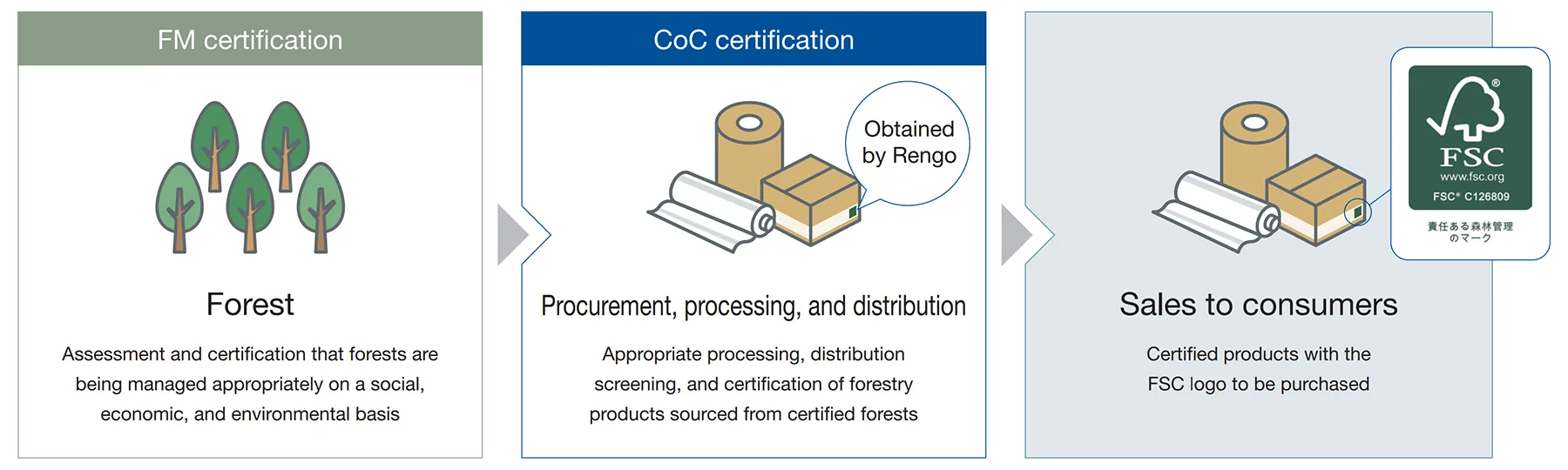
FSC certification is an international system for authenticating and certifying both appropriately managed forests and the appropriate processing and distribution of lumber harvested from these forests. In the case of corrugated packaging, FSC certification must be obtained not only by the corrugated plant that processes the corrugated packaging but also by the paperboard mill that manufactures containerboard, the raw material of corrugated packaging.
Record of acquisition for FSC certification (CoC certification)*
- December 2013: Boxboard
- July 2014: Chipboard
- February 2015: All types of containerboard
- August 2015: All types of corrugated packaging and folding cartons
- July 2016: Tube board
- September 2020: Cellulose-related products from the Takefu Plant
*FSC®C119241, FSC®C126809
Now that the Takefu Plant has obtained certification, all of our products made from wood pulp can be supplied as FSC-certified products. We will continue to contribute to responsible forest management through our raw material procurement, product manufacturing, and supply activities.
Structure of the FSC Certification System
Clean Wood Act initiatives
Japan’s Act on Promoting the Distribution and Use of Legally Harvested Wood and Wood Products (the Clean Wood Act) went into force in May 2017, and the Rengo Group became a registered wood-related business operator in March 2018. To minimize the risk of purchasing wood or wood products that have been illegally harvested, we created and use a legal certification due diligence system manual. The Group will continue to implement measures in accordance with the Clean Wood Act. This manual is available on our website (Japanese).